Pen beat turns a pen and a desk into a drum kit. The tip of the pen and the back of the pen make two different sounds; once you can play those two evenly, you can arrange them into patterns that sound like a beat. There is nothing to buy. Ten focused minutes will give you a working grip and your first two taps, which is everything the rest of the style is built on.
What you need before the first tap
Small setup choices decide whether your first session sounds crisp or muddy.
- A hard, flat surface. A wooden desk is ideal. Glass is harsh and unpleasant to play on, and padded mats or fabric-covered tables swallow the sound. If your desk is soft, put a hardback book or a wooden chopping board on it.
- A cheap ballpoint or gel pen. A standard biro with a firm barrel and a bit of weight. Very light pens bounce around; expensive ones make you cautious.
- A chair at the right height. You want your elbows roughly level with the desk so you are not hunching.
- A clear patch of desk about the size of a sheet of A4.
- A metronome or a ticking clock. Counting out loud works too.
Posture and grip
Sit at the desk
Sit a little forward with your feet flat and your shoulders down. Let your forearm rest lightly on the edge of the desk, or hover just above it. Resting is fine; pressing down is not. Your wrist needs to move freely in both directions, so keep your elbow away from your ribs and your shoulders relaxed.
The seesaw grip
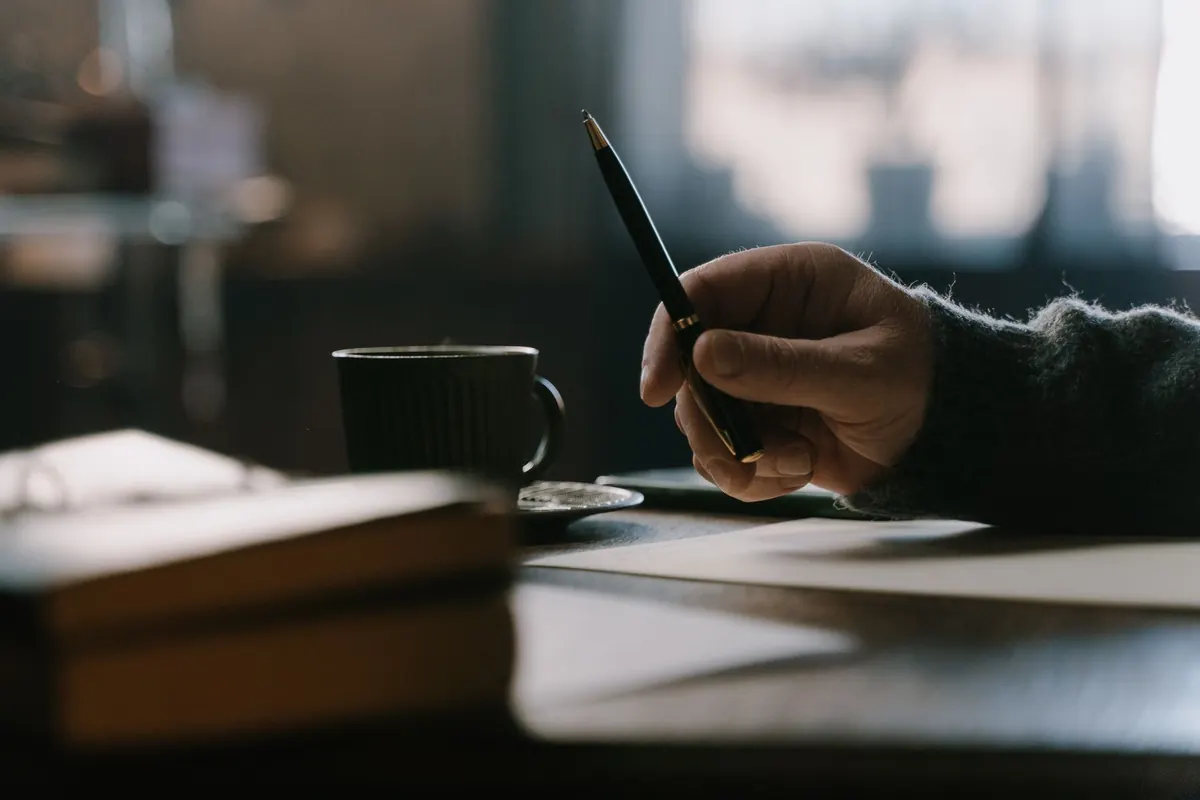
Hold the pen in your dominant hand and pinch it between thumb and index finger a couple of centimetres back from the tip, so a short length of pen sticks out in front. The tip points down towards the desk and slightly away from you; the back end points up and back towards your wrist. The other three fingers curl loosely underneath and do very little.
Think of the pen as a seesaw balanced on your fingers. Press the front down and the tip hits the desk. Roll the back down and the other end hits. Every sound in pen beat comes from that single movement.
Keep the grip light — firm enough that the pen will not slip, loose enough that it pivots. If your fingertips turn white, you are squeezing.
Tap one: the front tap
Pick a spot on the desk about a hand's width in front of you and keep returning to it. Angle the pen so the tip points down at roughly forty-five degrees, then drop the tip onto the desk with a small movement from the wrist. Let the pen fall rather than pushing it. The sound comes from the impact, not from pressure, so lift straight after the strike and let it bounce. Front taps are bright and sharp — the highest sound you will make.
Play twenty in a row, slowly, aiming for the same volume and the same gap between them. If your hand starts to ache, you are working too hard.
Tap two: the back tap
From the same grip, roll the pen so the tip lifts and the back end swings down to the desk. Thumb and index finger do most of the work and the wrist follows. Because the back end is heavier and meets the desk with a flatter surface, the sound is lower and fuller than a front tap.
The action should feel like a flick, not a chop. If your whole arm is swinging, rest your forearm on the desk for a minute and try again. Twenty back taps, same spot, same volume.
Joining the two taps
Alternating is where the two sounds start to become music, and it is also where beginners speed up too soon. Set a metronome to 60 beats per minute — one beat per second — and count out loud as you play.
- Eight front taps, one per beat.
- Eight back taps, one per beat.
- Sixteen alternating taps: front, back, front, back.
- If that stays even, try a short pattern: front, front, back, back.
- Raise the tempo only when the pattern is steady at 60.
Evenness beats speed every time. A slow pattern played deliberately is worth more than a fast one that collapses after four taps.
Common beginner problems
- White knuckles. Your grip is too tight. Loosen your fingers and start again.
- The whole arm moving. Anchor your forearm and let the wrist and fingers do the work.
- Hitting a different spot every time. This is the usual reason a pattern sounds uneven. Choose one spot and stay on it.
- Practising fast too early. Slow down until it is clean, then speed up.
- Sore hands. Pen beat is repetitive. Keep sessions short, and if pain in your wrist or fingers persists, get it checked by a physiotherapist or your GP.
Your first ten minutes, minute by minute
Here is a session you can repeat tomorrow and the day after.
- Minute 0–1: clear the desk, choose your pen, sit down, check that your elbows are level with the desk top.
- Minute 1–2: grip only. Roll the pen between your fingers and feel the seesaw.
- Minute 2–4: front taps. Pause every ten taps and check that your grip is still loose.
- Minute 4–6: back taps. Same spot, same volume.
- Minute 6–8: alternate at 60 bpm, counting out loud.
- Minute 8–9: try front, front, back, back as slowly as you need.
- Minute 9–10: shake out your hands and note the tempo you managed.
That is the whole first session. Do it again tomorrow rather than playing for an hour tonight. Short daily practice builds the muscle memory; long occasional sessions mostly build tension.
Once front and back taps feel automatic, you can move on to the other sounds in pen beat, which use your hand as a surface as well as the desk. There is no rush. Two clean sounds played evenly already sound like a beat.
Photo: cottonbro studio / Pexels